The soil profile shifts dramatically between downtown Montgomery’s river terrace and the chalky prairie uplands toward Maxwell AFB. Where the Alabama River cut through the Selma Chalk, you encounter stiff, sometimes weathered limestone residuum; just a few miles east, the Black Belt’s shrink-swell clays dominate. That contrast means a one-size-fits-all bearing assumption fails here routinely. Our soil mechanics study maps those transitions before a single footing is poured. We run full physical index testing—grain size distribution per ASTM D2487, Atterberg limits, moisture-density relationships—and correlate the numbers with local geology so the foundation recommendation fits the actual stratum under the site. Montgomery’s hot, humid summers accelerate desiccation cracking in near-surface clays, and our lab protocols account for that seasonal moisture variation when interpreting undisturbed sample strength. For sites near creeks feeding the Tallapoosa River, we often combine the field investigation with a CPT test to capture continuous soil behavior in soft alluvium without the disturbance of conventional sampling.
Montgomery’s Black Belt clays can swell 10 percent volumetrically between August drought and January rain; our lab test program captures that full seasonal envelope.
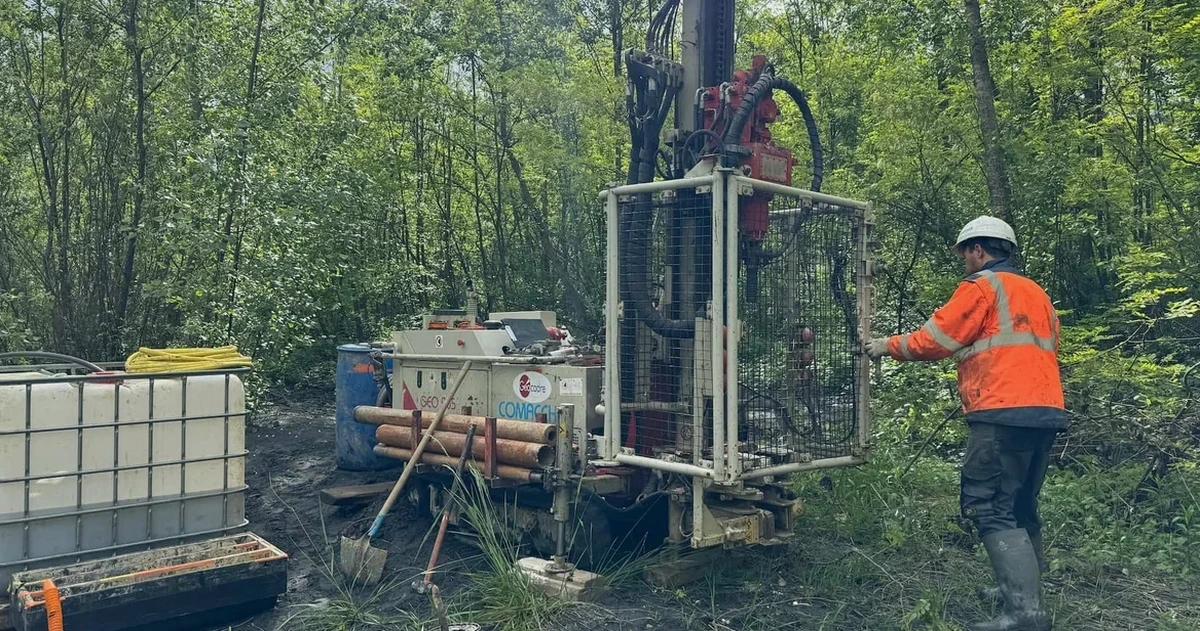
How we work
Local context
The most common mistake we see in Montgomery is treating the stiff desiccated crust as representative of the entire soil column. A contractor drills in August, hits hard brown clay at 4 feet, and assumes 4,000 psf bearing is safe. Then the winter rains come, the crust softens, and footings begin to settle differentially within six months. That surface crust is only 3 to 6 feet thick over much of the Black Belt; below it, the clay is normally consolidated and much weaker. Our soil mechanics study explicitly tests both the crust and the underlying soft zone as separate engineering units. Another recurring failure is ignoring the chalk solutioning voids that appear in the western part of the city: a standard boring can miss a void by inches, but our lab program flags anomalous loss of drilling fluid and carbonate content shifts that signal karst features requiring geophysical follow-up. Montgomery’s building department increasingly requires this two-zone characterization for any structure exceeding two stories, and skipping it has led to litigation over cracked slabs in several recent subdivision builds east of I-85.
Video overview
Relevant standards
ASTM D2487 – Standard Practice for Classification of Soils for Engineering Purposes (Unified Soil Classification System), ASTM D1586 – Standard Test Method for Standard Penetration Test (SPT) and Split-Barrel Sampling of Soils, ASTM D2850 – Standard Test Method for Unconsolidated-Undrained Triaxial Compression Test on Cohesive Soils, IBC Chapter 18 – Soils and Foundations (adopted by City of Montgomery Building Code), ASCE 7 – Minimum Design Loads and Associated Criteria for Buildings and Other Structures
Additional services
Physical Index & Classification Testing
Grain size analysis by sieve and hydrometer, Atterberg limits, specific gravity, and organic content determination per ASTM D2487. We classify every specimen in-house so the field log and lab log match by the same unified criteria, avoiding the disconnect that plagues reports where drilling and testing are handled by separate firms.
Strength & Consolidation Testing
Triaxial compression (UU, CU, CD paths), direct shear, and one-dimensional consolidation per ASTM D2435. For Montgomery’s compressible Black Belt clays, we run timed-load consolidation frames that generate the compression index and preconsolidation pressure needed for accurate settlement calculations under mat or spread footings.
Foundation Parameter Report
Integration of field SPT/CPT data with laboratory strength results to deliver allowable bearing pressure, modulus of subgrade reaction, and settlement estimates. The report cross-references Montgomery County soil survey mapping and addresses the specific shrink-swell mitigation measures required by the local building official for slab-on-grade construction.
Typical parameters
Quick answers
What is the typical cost for a soil mechanics study on a residential lot in Montgomery?
For a standard single-family residential parcel in Montgomery, a complete soil mechanics study that includes two borings with SPT sampling, laboratory classification, Atterberg limits, unconfined compression tests, and a signed foundation recommendation letter generally runs between US$3,080 and US$5,180. The spread depends on lot size, depth to refusal, and whether shrink-swell potential testing is required by the lender or the City of Montgomery building department. Sites near the river or in the chalk zone may need additional consolidation testing, which adjusts the final fee accordingly.
How deep do you test for a soil mechanics study in Montgomery’s Black Belt clays?
The investigation depth depends on the foundation type and structural load. For slab-on-grade construction, we typically sample to 15 feet below grade because Montgomery’s active moisture zone extends to about 12 feet in the fat clays of the Black Belt; this captures the full seasonal swell-shrink profile. For shallow footings under two- to three-story buildings, borings usually reach 20 to 25 feet to penetrate the desiccated crust and characterize the underlying normally consolidated clay. Where deep foundations are under consideration, we extend borings to at least 10 feet below the pile tip elevation and run laboratory consolidation tests on the bearing stratum.
How long does it take to receive the final soil mechanics report in Montgomery?
Routine residential and light commercial reports are delivered within 10 to 14 business days after field sampling. The laboratory timeline is driven by the consolidation tests: incremental loading frames require roughly 24 to 48 hours per specimen depending on the drainage characteristics of Montgomery’s high-plasticity clays. Strength tests on sandy material run faster, but we never shorten the consolidation schedule artificially because the settlement parameters derived from those tests govern the foundation design. Expedited turnaround within 7 business days is available when the construction schedule cannot accommodate the standard window, with priority given to triaxial and consolidation frames.