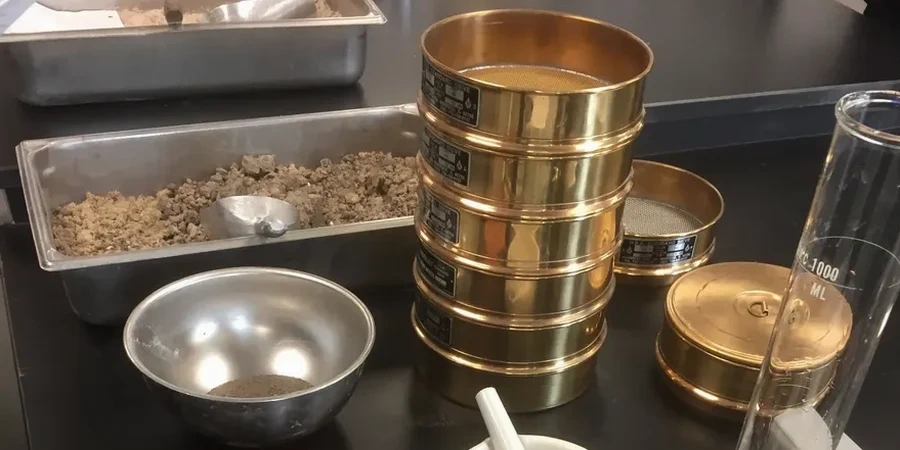
The stack of sieves clicks into place inside the Ro-Tap shaker. Eight inches in diameter. Brass frames. Mesh openings from three-quarter inch down to a Number 200. That fine pan at the bottom catches what passes through everything else. In Montgomery, we follow that with the hydrometer test. A tall glass cylinder. A calibrated bulb floating in a slurry of minus-200 soil. We take readings at 2 minutes, 5 minutes, 15 minutes. The whole curve matters here because Montgomery sits on the Fall Line. Piedmont residual silts to the north shift into Coastal Plain sands and the famous Black Belt clays just west of downtown. Getting the full distribution right determines whether a pad drains or traps water underground. Our lab runs the combined method on every sample from East Montgomery to Prattville, and the setup is calibrated to ASTM D2487 and D7928 standards every morning before the first test.
Montgomery's Black Belt clays hide a fine fraction that the Number 200 sieve misses completely—the hydrometer catches what compaction plans ignore.
How we work
Local context
A common mistake we see on Montgomery commercial projects is trusting a quick field classification without the hydrometer. A contractor grabs a handful of soil near the Hyundai plant access road and calls it sandy clay based on feel. The sieve-only curve looks like a well-graded SC. But the hydrometer reveals 18 percent colloidal fines. That changes the Unified Soil Classification to CH. The original compaction spec targets 95 percent of standard Proctor density. With that much colloidal clay, achieving density requires a moisture window of plus or minus 2 percent. Miss that window by a few percentage points and the fill pumps under the roller. We have seen pads rejected by the geotechnical inspector during proofrolling because the lab curve didn't include the hydrometer tail. For deep excavations in that same Black Belt clay, skipping the full grain size analysis also throws off the lateral earth pressure assumptions in the deep excavation design. The difference between a silt and a fat clay changes the active pressure coefficient enough to require a heavier shoring system.
Relevant standards
ASTM D6913/D6913M-17 — Standard Test Methods for Particle-Size Distribution (Gradation) of Soils Using Sieve Analysis, ASTM D7928-21e1 — Standard Test Method for Particle-Size Distribution (Gradation) of Fine-Grained Soils Using the Sedimentation (Hydrometer) Analysis, ASTM D2487-17 — Standard Practice for Classification of Soils for Engineering Purposes (Unified Soil Classification System), IBC 2021 Section 1803 — Geotechnical Investigations, referencing ASCE 7 classification requirements
Additional services
Full ASTM D6913 + D7928 Combined Analysis
Complete grain size distribution from 3-inch gravel down to 0.001 mm clay colloids. Includes wash loss, dry sieve stack, and 24-hour hydrometer sedimentation. Delivered as a gradation curve with D10, D30, D60, Cu, Cc, and USCS classification per ASTM D2487.
Sieve-Only Analysis (Coarse Fraction)
For granular borrow sources and concrete aggregate checks. Covers the range from coarse gravel to the No. 200 sieve. We provide percent passing each sieve, fineness modulus for concrete sand, and a rapid grading report. Turnaround in 24 hours for urgent compaction trials.
Typical parameters
Quick answers
How much does a combined sieve and hydrometer analysis cost in Montgomery?
Our combined grain size analysis with both sieve and hydrometer runs between US$90 and US$210 per sample, depending on how many splits are needed and whether the sample contains a large coarse fraction above 3 inches. Standard turnaround is three business days. Rush service for a single split adds a small surcharge.
How long does the hydrometer portion of the test take?
The sedimentation phase takes at least 24 hours. We take readings at 2, 5, 15, 30, 60, 250, and 1440 minutes. The overnight reading at 24 hours captures the finest clay fraction. If your project timeline is tight, we can run the sieve portion first and follow up with the hydrometer curve the next day.
Do you handle organic soils from the Alabama River floodplain?
Yes. For samples with visible organic material we run a loss on ignition test before the grain size analysis. Organic matter skews the sedimentation readings because it floats and decays. We remove it with hydrogen peroxide pretreatment per ASTM D7928 so the curve reflects only the mineral fraction.
What classification system do you use for the final report?
We classify every sample under the Unified Soil Classification System per ASTM D2487. The report lists the group symbol (GW, SP, CL, CH, etc.) and the group name. For Montgomery projects that require AASHTO classification for pavement design, we include that as an additional column in the summary table.