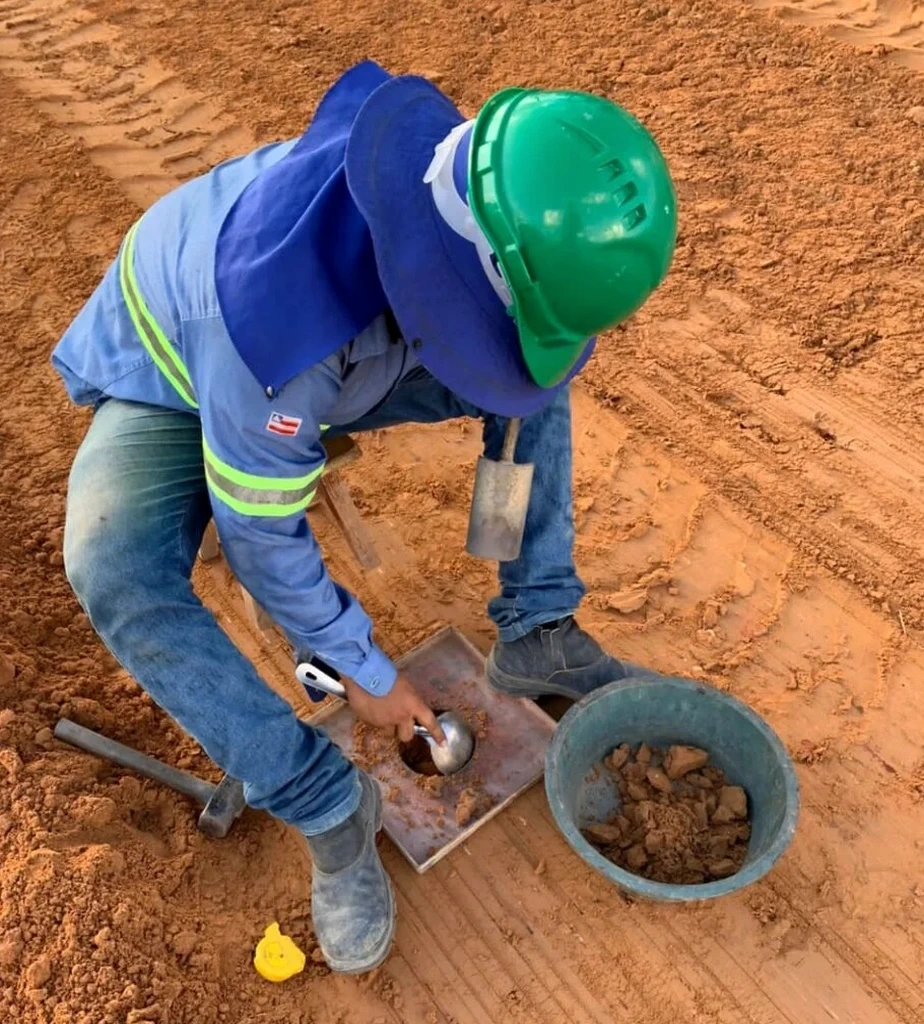
A steel base plate sits flat on leveled grade. A hand auger bores a precise hole into the compacted lift. The sand cone device—an inverted glass jar attached to a metal cone valve—is inverted, opened, and calibrated Ottawa sand flows into the void. That simple sequence is how we measure in-place density on Montgomery jobsites. The sand cone test remains the most direct way to confirm that a contractor’s compaction effort meets project specifications. Crews working the heavy clay residuum common across the Fall Line know that a passing nuclear gauge reading doesn’t always tell the full story. We run the sand cone when the spec calls for ASTM D1556 and the owner’s representative wants a primary reference method. Before a footing pour on a commercial pad off the Boulevard, pairing the field density check with a plate load test gives the structural engineer direct bearing capacity confirmation right at the tested elevation.
A sand cone result is a single data point. The real value comes from pattern testing across the lift and comparing trends, not isolated numbers.
How we work
Local context
Montgomery sits at roughly 240 feet above sea level on the Fall Line, where the Piedmont metamorphic rock gives way to the Coastal Plain. That transition zone creates erratic fill deposits—clay, weathered mica schist, and old alluvium mixed in the same lift. A fill that looks uniform on the surface can vary 15 percentage points in relative compaction across fifty feet. The risk multiplies when site grading moves fast during the dry fall window and fill moisture drifts below optimum. A sand cone test run on material compacted dry of optimum will often hit the density number but fail later when the soil wets up and collapses. We have pulled cores under slab-on-grade foundations in east Montgomery where the top four inches were tight and the underlying 12 inches were loose. That failure mode is invisible without either a test pit or a carefully executed density program that checks the full lift thickness. Alabama’s high rainfall—over 50 inches annually—accelerates the wetting cycle and turns marginal compaction into a maintenance liability within two years.
Relevant standards
ASTM D1556 — Standard Test Method for Density and Unit Weight of Soil in Place by the Sand-Cone Method, AASHTO T 191 — Density of Soil In-Place by the Sand-Cone Method, ASTM D1557 — Standard Test Methods for Laboratory Compaction Characteristics of Soil Using Modified Effort, ASTM D698 — Standard Test Methods for Laboratory Compaction Characteristics of Soil Using Standard Effort, IBC Section 1805 — Compaction requirements for structural fill
Additional services
Field Density Acceptance Testing
ASTM D1556 sand cone testing on compacted fill, utility trench backfill, and building pad subgrades. We provide real-time pass/fail results on site and a formal report within 24 hours, including moisture content, dry density, and percent compaction relative to the lab Proctor.
Laboratory Compaction Curves
Modified Proctor (ASTM D1557) and Standard Proctor (ASTM D698) curves run in our lab on project-specific borrow material. The lab curve is the reference standard that every field density test is measured against.
Typical parameters
Quick answers
Why use the sand cone method instead of a nuclear density gauge in Montgomery?
The sand cone is the referee method. Nuclear gauges are fast and useful for production tracking, but they require site-specific calibration against a sand cone reference. When a gauge reading is borderline or disputed, the sand cone provides a direct physical measurement that doesn't depend on the soil's chemical composition or moisture interference. In Montgomery's residual clays, which can contain mica and iron concretions, gauge readings sometimes drift. A sand cone result cuts through that uncertainty.
How much does a field density test cost on a Montgomery project?
Individual sand cone density tests in the Montgomery area typically run between US$90 and US$140 per test, depending on the number of tests scheduled per mobilization and the site location. A full-day testing program with multiple stations is more cost-effective per test than a single-point callout. We provide a firm quote after reviewing the project grading plan and the required testing frequency.
How many sand cone tests does the IBC require for a commercial building pad?
The International Building Code references ASTM D1556 as an accepted method but doesn't prescribe a fixed number of tests. Frequency is set in the project geotechnical report and the earthwork specification. A common rule of thumb for commercial building pads in Alabama is one test per 2,500 square feet per lift, or a minimum of three tests per lift for smaller pads. The engineer of record has final authority on testing frequency based on the site variability observed during grading.