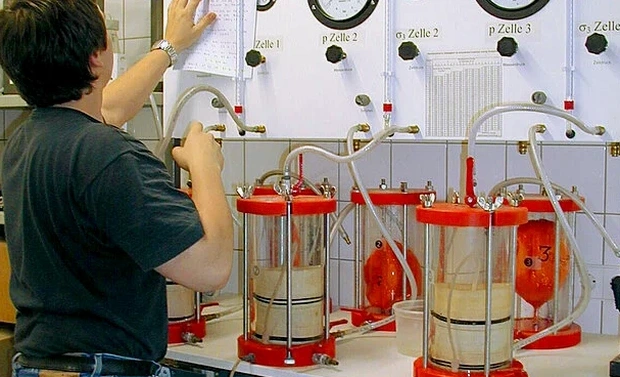
Too many local contractors in Montgomery trust a visual inspection of red clay and call it a day, only to watch their asphalt crack after two seasonal cycles. The problem with the expansive soils common across the Alabama Black Belt is that what looks like solid ground on a dry August afternoon can turn into a softened, low-strength layer by February. A laboratory CBR test eliminates that guesswork. We take a remolded or undisturbed sample, soak it for 96 hours to simulate the worst-case saturation scenario these Piedmont-derived silts and clays will ever see, and measure penetration resistance against a standard load.
The resulting CBR value directly feeds into the AASHTO 1993 pavement design equation, which ALDOT still references for many local road and commercial parking lot projects. Our lab in the Montgomery area runs the California Bearing Ratio test under ASTM D1883, and we often pair it with a grain size analysis to confirm the fines content that drives the expansive behavior of the region's weathered mica schist residual soils.
A soaked CBR value of 3% versus 6% can double the required aggregate base thickness in a Montgomery parking lot — that single number drives the entire pavement cost.
How we work
When we prepare a sample, we compact it at the optimum moisture content from a modified Proctor, then submerge it. The swell measurement we take before penetration is often the real headline in Montgomery — we have seen vertical swell exceed 4% in some high-plasticity clays from the Tuscaloosa Group formation.
For projects requiring a more continuous strength profile, we also support fieldwork with CPT testing to correlate tip resistance with CBR, giving the design engineer a complete picture from the lab bench to the field.
Local context
A developer we worked with had a site off Troy Highway near the Hyundai plant expansion area — a light industrial building with a parking lot designed for 40 trucks daily. The geotech report from a previous firm had skipped the soaked CBR test, assuming a design CBR of 10 based on a dry strength classification. 14 months after construction, the pavement had alligator cracking across half the lot. We pulled Shelby tube samples from below the base layer and ran the laboratory CBR test properly, soaked for 96 hours. The field-equivalent CBR came back at 2.8.
The subgrade was a micaceous silt that looked competent in hand specimens but lost nearly 70% of its strength when saturated. The fix required a full-depth reclamation with lime stabilization, which cost roughly three times what the original design would have cost if the soaked CBR had been known from the start. In Montgomery, where we get 52 inches of rain a year and the water table rises into the subgrade zone every winter, skipping the soaked CBR is a financial gamble that rarely pays off.
Relevant standards
ASTM D1883-21: Standard Test Method for California Bearing Ratio (CBR) of Laboratory-Compacted Soils, AASHTO T 193: Standard Method of Test for The California Bearing Ratio, AASHTO Guide for Design of Pavement Structures, 1993 (referenced by ALDOT), ALDOT Standard Specifications for Highway Construction, Section 301: Soil-Lime and Soil-Cement Subgrade Treatment
Additional services
Soaked CBR with Swell Potential Measurement
Full 96-hour immersion test with daily swell readings, penetration resistance curve, and corrected CBR values at 0.1 and 0.2 inches. We report both the as-compacted and soaked bearing ratio, plus the percent swell, which is critical for Montgomery's high-PI residual clays.
CBR-Based Pavement Section Design Input
We provide the design CBR value for each soil layer encountered, formatted for direct input into AASHTO flexible pavement design software or ALDOT's standard pavement thickness tables. Includes recommendations for lime or cement stabilization if the soaked CBR falls below 3.
Typical parameters
Quick answers
What is the typical cost of a laboratory CBR test in Montgomery, AL?
For a standard ASTM D1883 soaked CBR test on a single remolded specimen, the cost ranges from US$120 to US$230, depending on whether a companion modified Proctor test (ASTM D1557) is required to establish the compaction curve. If we are working with undisturbed Shelby tube samples from a site investigation, the price stays within that same range per specimen. Multi-point CBR programs for larger projects are quoted on a per-project basis.
How long does a soaked CBR test take to complete in the lab?
The full procedure takes 5 to 7 working days from sample preparation to final report. The 96-hour soaking period is the primary driver of the timeline and cannot be shortened without violating ASTM D1883. We record swell readings every 24 hours during the soak, which gives us the swell-versus-time curve that is essential for evaluating expansive subgrade behavior common in Montgomery's Coastal Plain soils.
Can you run a CBR test on an undisturbed sample, or only on remolded soil?
We run both. Remolded specimens compacted at modified Proctor effort are the standard method for pavement design, because they represent the subgrade after construction compaction. However, we also test undisturbed Shelby tube samples when the project needs to evaluate the in-place CBR of an existing subgrade — for example, during a forensic investigation of a failed pavement or when assessing an old roadbed before an overlay. The penetration test procedure is identical in both cases, per ASTM D1883.