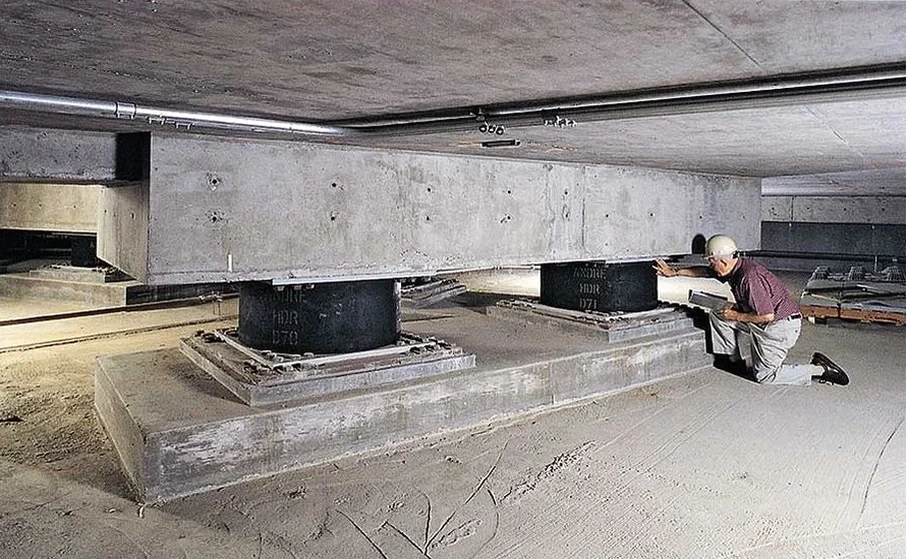
Montgomery sits on the Gulf Coastal Plain, underlain by the Selma Group Chalk and unconsolidated Cretaceous sediments. The U.S. Geological Survey places the city in a moderate seismic hazard zone, with peak ground acceleration values reaching 0.15g for a 2% probability in 50 years. These soft sedimentary deposits can amplify ground motion. We design base isolation systems specifically for this soil profile. A standard isolation interface decouples the superstructure from the substrate motion. For sites near the Alabama River with thicker alluvial deposits, we combine our design with seismic microzonation to refine the acceleration spectra before selecting isolator properties. The team applies IBC Chapter 17 and ASCE 7-22 Section 17 for analysis and prototype testing.
A properly tuned isolator shifts the fundamental period to 3 seconds and cuts spectral acceleration by 60-70% compared to a fixed-base structure.
How we work
Local context
The most frequent error we see in Alabama projects is specifying an isolation system using West Coast ground motion records. Montgomery's seismicity is dominated by the Eastern Tennessee Seismic Zone and the New Madrid far-field effects, which produce longer-duration, lower-frequency shaking than a typical California crustal event. Designing for a wrong seismological model underestimates the displacement demand on the bearings. Another critical mistake is ignoring the low shear strength of the weathered Selma Chalk directly below the isolator pedestals. If the bearing pier does not penetrate to competent rock, a punching failure can occur during the first large displacement cycle. We always pair the superstructure isolation design with a plate load test at the bearing pad elevation to confirm the allowable bearing pressure under the heavily loaded perimeter isolators.
Video overview
Relevant standards
ASCE/SEI 7-22: Minimum Design Loads - Chapter 17, IBC 2021: International Building Code - Section 1705, AASHTO Guide Specifications for Seismic Isolation Design, ASTM D4015: Standard Test Methods for Modulus and Damping of Soils by Resonant-Column
Additional services
Nonlinear Time-History Analysis
We run 11 ground motion pairs (2 horizontal components each) scaled to the Montgomery-specific uniform hazard spectrum, including near-fault pulse effects from the ETSZ.
Prototype Testing Oversight
We prepare the test matrix and witness the full-scale bearing tests per ASCE 7-22 Section 17.8 at an accredited lab, verifying the three-cycle hysteresis loops.
Peer Review Package
Complete calculation package with isolator data sheets, site-specific hazard deaggregation, and base shear time histories, formatted for the Alabama Building Commission review.
Typical parameters
Quick answers
What is the typical cost range for base isolation design on a Montgomery mid-rise building?
For a standard 4-8 story steel or concrete frame structure in Montgomery, the full isolation design package, including nonlinear analysis, prototype testing oversight, and construction specifications, runs between US$4,670 and US$9,650. The final figure depends on the number of isolator types and the complexity of the moat wall detailing.
Does ASCE 7 require a peer review for isolated structures?
Yes. ASCE 7-22 Section 17.10 mandates an independent peer review for any structure with an isolation system, unless the structure is a single-family dwelling. The review covers the ground motion selection, isolator properties, and the nonlinear analysis model.
What soil conditions in Montgomery require special isolator design?
Sites with Site Class E or F (thick alluvial deposits along the Alabama River floodplain or liquefiable sands) require a site-specific hazard analysis. In these cases, we adjust the isolator effective stiffness and damping to compensate for the soil amplification at longer periods, often using a double-concave friction pendulum instead of LRB to handle the larger displacement demand.
Can you retrofit base isolators to an existing Montgomery building?
It is possible but complex. The existing columns must be cut and lifted to insert the isolators, usually at the ground floor level. We must verify that the existing column reinforcement can transfer the diaphragm forces above the isolation interface. A detailed excavation monitoring plan is required during the column jacking phase to control differential settlement on the aging Selma Chalk.