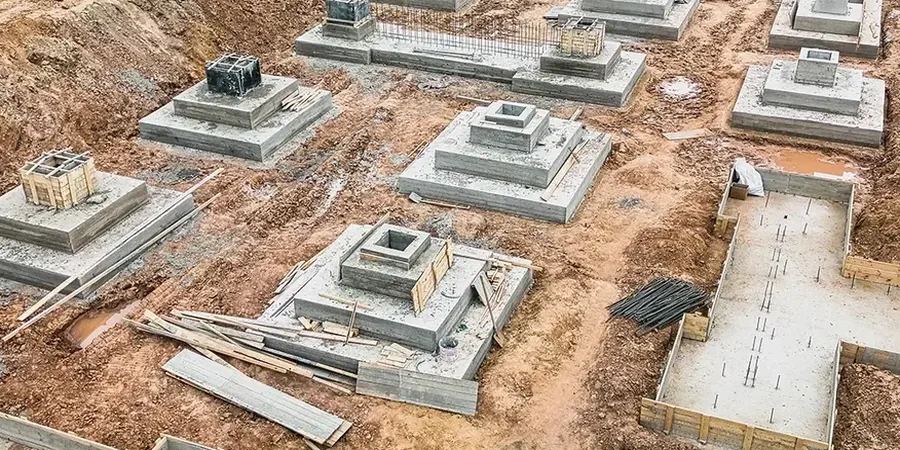
The rig rumbles onto the lot in Montgomery with a Delmag D19-42 diesel hammer, ready to drive a load test pile into the Selma Chalk. At our lab, pile foundation design in Montgomery starts with a hammer, a mandrel, and a set of strain gauges embedded along the rebar cage. The Alabama Blackbelt doesn't forgive shallow footings; the Yazoo Clay Formation swells and shrinks with every wet-dry cycle. We tie into the IBC 2021 and the Alabama Building Code to develop pile capacities that bypass the active zone entirely. For soft alluvial pockets near the Alabama River, our design often specifies end-bearing H-piles driven to refusal on the chalk. Before setting the pile cap elevation, we coordinate closely with the CPT test crew to correlate tip resistance with SPT blow counts from the adjacent SPT drilling program. That field data feeds directly into our CAPWAP analysis and static design models, ensuring the pile section and embedment length match the actual stratigraphy encountered beneath Montgomery County.
A pile driven to refusal on Selma Chalk can carry 120 tons in compression, but the same pile 30 feet west might float in Yazoo Clay at half that capacity.
How we work
Local context
Two miles separate the sandy terrace deposits along Bell Street from the fat clays on the east side of I-65 near Eastdale Mall, and the pile design changes radically between them. In the sandy zone, driven precast concrete piles might reach refusal at 55 feet; in the clay zone, that same section could require 90 feet of embedment to develop adequate uplift resistance. The biggest risk we encounter in pile foundation design in Montgomery is underestimating downdrag from consolidating fill. Developers sometimes place 8 to 12 feet of compacted fill to raise the pad above the floodplain, and that fresh fill settles over 5 to 7 years, dragging on the pile shaft. We calculate downdrag loads per the neutral plane method in FHWA HI-97-013 and add that to the structural axial demand. Another failure mode we see in forensics work involves pile groups spaced too tightly in the stiff Yazoo clay; group efficiency drops below 0.7 when center-to-center spacing falls under 2.5 diameters. We avoid that by modeling the group as a block foundation in LPILE and checking the reduced modulus. Our retaining wall designs near pile caps also require a separate lateral squeeze analysis, especially when the excavation extends below the pile cap into the active clay zone.
Video overview
Relevant standards
IBC 2021 (International Building Code), Chapter 18, ASCE 7-22 Minimum Design Loads for Buildings, ASTM D4945 Standard Test Method for High-Strain Dynamic Testing of Deep Foundations, ASTM D1143 Standard Test Methods for Deep Foundation Elements Under Static Axial Compressive Load, FHWA NHI-16-009/010 Drilled Shafts and Driven Piles
Additional services
Driven Pile Design and Dynamic Testing
Full design of H-pile, pipe pile, and precast concrete pile foundations per IBC 1810 and AISC 360. We perform wave equation analysis (GRLWEAP) for driveability, specify hammer size and cushion stiffness, and mobilize a Pile Driving Analyzer (PDA) for high-strain testing. Signal matching with CAPWAP software validates unit skin friction and end bearing against our static formulas. We also design lateral load tests using a reaction frame and hydraulic jack per ASTM D3966.
Drilled Shaft and Augercast Pile Design
Design of drilled shafts (caissons) and continuous flight auger (CFA) piles for sites with low headroom or vibration restrictions near historic Montgomery structures. We specify casing lengths through the Yazoo Formation, design the rebar cage for combined axial and lateral loads, and supervise Osterberg cell testing (ASTM D8169) when static load test reaction frames aren't feasible. Concrete mix designs include sulfate-resistant cement (Type II/V) per ACI 318 for the acidic groundwater common in the Blackbelt.
Typical parameters
Quick answers
How deep do piles need to go in Montgomery to bypass the expansive Yazoo Clay?
In Montgomery County, the Yazoo Clay active zone typically extends 15 to 22 feet below grade. We design pile tips to bear at least 30 feet deep, or deeper if the Selma Chalk is not encountered. The exact depth is determined by test borings and confirmed with a static load test per ASTM D1143.
What type of pile works best for the Blackbelt soils around Montgomery?
Driven H-piles and closed-end pipe piles perform well when end-bearing on the Selma Chalk. For sites with thick alluvial deposits near the Alabama River, drilled shafts or augercast piles provide better skin friction and can be extended deeper without splicing. The selection depends on the subsurface profile, access constraints, and structural loads.
How do you account for downdrag from fill settlement in pile design?
We calculate the neutral plane depth using the FHWA method, estimate the unit negative skin friction from the fill's shear strength, and add that downdrag load to the structural demand on the pile. Bitumen coating or oversized sleeves are sometimes specified to reduce downdrag in the upper 10 to 15 feet.
What is the typical cost range for pile foundation design in Montgomery?
A complete pile foundation design package—including geotechnical investigation, static analysis, dynamic testing, and sealed construction drawings—generally ranges from US$1,770 to US$5,940 depending on the number of borings, pile load tests, and the complexity of the site conditions.
Does the Montgomery floodplain requirement affect pile foundation design?
Yes. FEMA regulations and the Montgomery floodplain ordinance require that the lowest floor elevation be at or above the Design Flood Elevation (DFE) plus 2 feet of freeboard. We set the pile cutoff elevation to meet this requirement, and all pile materials below the DFE must be resistant to corrosion and decay—typically concrete or steel with a protective coating.