Montgomery sits at an elevation of 240 feet above sea level, draped over the Cretaceous and Tertiary sediments of the Gulf Coastal Plain. Designing a shallow foundation here means confronting the Selma Chalk formation to the west and Pleistocene terrace deposits closer to the Alabama River. With an annual rainfall of 53 inches, moisture-sensitive clays dominate the near-surface profile, demanding careful bearing capacity calculations and settlement predictions under IBC Chapter 18 and ASCE 7 load combinations. A CPT test can rapidly delineate the transition from desiccated crust to softer underlying strata, and for projects on mixed fill we often pair it with a grain size analysis to confirm drainage characteristics before sizing the footing.
On Montgomery's expansive clays, a shallow foundation lives or dies by the moisture barrier — underslab vapor retarders and positive drainage aren't optional, they're structural.
How we work
- Shear strength profiles from unconsolidated-undrained triaxial tests on Shelby tube samples
- Consolidation parameters (Cc, Cr, Pc) from one-dimensional oedometer tests on high-plasticity clays
- Groundwater monitoring across wet and dry seasons to capture the perched water table common in the Tuscaloosa Group residuum
Local context
Downtown Montgomery, built on the high terrace deposits near the river bluffs, behaves fundamentally differently from the low-lying alluvial flats of Maxwell Air Force Base. On the bluffs, a footing might bear on a stiff, desiccated crust that masks softer clay at depth — punching shear becomes a real risk if the crust is thinner than twice the footing width. Down in the floodplain, loose saturated sands from the Quaternary meander belt can densify under cyclic loading, introducing a seismic settlement component even at the moderate accelerations expected from the Eastern Tennessee Seismic Zone. Ignoring the seasonal moisture cycle in the upper five feet is the most common cause of edge-lift heave in lightly loaded slabs; we specify a capillary break and extended downspout leaders as part of every shallow foundation design package to mitigate this Montgomery-specific distress mechanism.
Video overview
Relevant standards
IBC 2021 (Chapter 18 – Soils and Foundations), ASCE 7-22 (Minimum Design Loads), ASTM D1586 (Standard Penetration Test), ASTM D2487 (Unified Soil Classification System), ACI 318-19 (Structural Concrete for Footings)
Additional services
Bearing Capacity & Settlement Analysis
Terzaghi, Meyerhof, and Vesic methods calibrated to site-specific shear strength data. We calculate immediate and consolidation settlement under sustained dead load plus reduced live load, and check angular distortion against IBC limits for flexible and rigid structures.
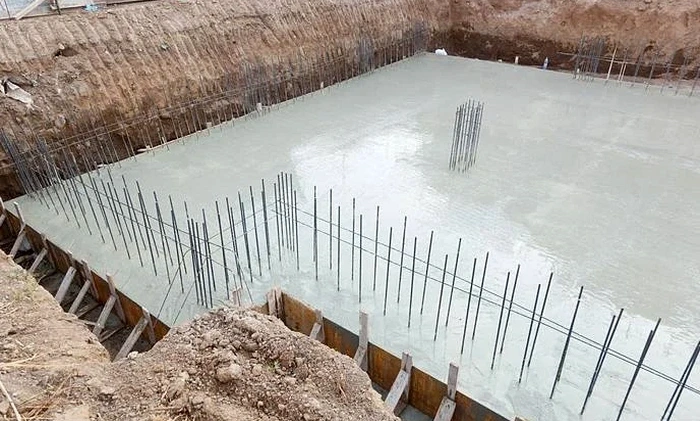
Slab-on-Grade & Mat Foundation Design
Design of stiffened slabs, ribbed mats, and post-tensioned foundations on expansive clays. We model soil-structure interaction using modulus of subgrade reaction derived from plate load tests or CPT correlations, and specify vapor barriers per ACI 302.1R.
Construction Phase QA/QC
Proof-rolling observation, footing bottom inspections to confirm bearing stratum consistency, field density testing of backfill, and concrete cylinder breaks to verify compressive strength. We provide a final compaction and foundation acceptance report for the building official.
Typical parameters
Quick answers
What is the typical cost range for a shallow foundation design on a single-family residential lot in Montgomery?
For a standard residential lot under 0.5 acres in Montgomery, a complete shallow foundation design package — including a subsurface exploration with two borings, laboratory testing, bearing capacity and settlement calculations, and a stamped report — typically ranges from US$2,140 to US$2,800. The final cost depends on access conditions, depth to competent bearing stratum, and whether groundwater monitoring is required.
How does Montgomery's soil affect footing depth and size compared to other parts of Alabama?
Montgomery sits squarely on the Black Belt's Selma Chalk and overlying terrace deposits. These residual clays are overconsolidated and can support higher bearing pressures than the Coastal Plain sands further south, but they're also highly expansive. Footings here are typically embedded at least 18 inches, not for frost protection but to get below the zone of seasonal moisture fluctuation. We often specify wider, more heavily reinforced strip footings to bridge soft spots in the alluvial pockets near creeks.
Do you need to perform a CPT test for every shallow foundation project in Montgomery?
Not every project requires a CPT test, but we recommend it for sites with known soft alluvium or where the stratigraphy is complex. A CPT provides a near-continuous profile of tip resistance and sleeve friction, which is invaluable for identifying thin, weak seams that a standard SPT boring might miss. For a straightforward single-story structure on the stiff terrace deposits, SPT borings with laboratory testing are usually sufficient.
What's the biggest mistake you see in local foundation construction?
The most frequent issue we encounter is inadequate surface drainage combined with no capillary break beneath slabs. Montgomery receives over 50 inches of rain annually, and when downspouts discharge next to the foundation, the clay soils swell and shrink seasonally. This cyclic movement can crack a slab-on-grade within three to five years. A simple 10-mil vapor retarder, free-draining backfill, and positive site grading would prevent the majority of these callbacks.