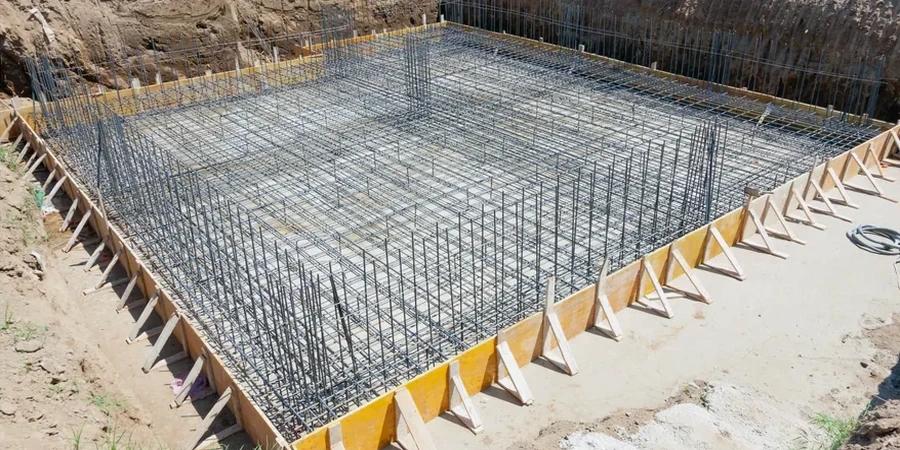
We were called out to a site near the Alabama River a few years ago where a developer had already poured footings for a mid-rise structure. Within two seasons, differential movement had cracked the slab in three places. The culprit was Montgomery's notorious Black Belt soil — a high-plasticity clay that swells when wet and shrinks when dry, exerting pressures that isolated footings simply cannot resist. That project, like many we see across the river region, was redesigned with a stiffened raft foundation. By distributing the building load across a continuous mat, we eliminated the differential settlement and provided a rigid platform that bridges soft spots in the Yazoo Clay formation. Before committing to a mat foundation in Montgomery, we combine CPT testing with laboratory consolidation curves to model the actual soil-structure interaction, and we often specify Atterberg limits testing to quantify the clay's expansion potential.
A properly designed raft turns Montgomery's expansive Yazoo Clay from a structural threat into a predictable, engineered bearing surface.
How we work
Local context
The USGS Quaternary fault maps show no active surface rupture hazard in Montgomery County, but the deeper Eastern Tennessee Seismic Zone can still deliver long-period motion that affects taller buildings on mat foundations. More immediate risks are soil-related. The Yazoo Clay formation, part of the Selma Group, contains montmorillonite layers with a swelling pressure exceeding 50 kPa when moisture increases by just 3%. A raft designed without accounting for edge-lift and center-lift distortion modes — the two primary failure mechanisms in expansive soils per the Post-Tensioning Institute's DC10.5 standard — will experience serviceability cracks within the first two wet-dry cycles. We have also encountered buried organics from old oxbow lakes east of downtown Montgomery; these pockets decompose slowly, causing long-term consolidation settlement that a standard geotechnical investigation might miss. Our approach mandates sampling at minimum 1.5 times the mat width laterally and down to the depth where the stress increment drops below 10% of the overburden, ensuring no compressible layer remains undetected.
Video overview
Relevant standards
IBC 2021 (International Building Code), ASCE 7-22 (Minimum Design Loads for Buildings and Other Structures), ACI 318-19 (Building Code Requirements for Structural Concrete), ASTM D1586 (Standard Test Method for SPT and Split-Barrel Sampling), ASTM D2487 (Classification of Soils for Engineering Purposes – USCS)
Additional services
Geotechnical investigation for mat foundations
Deep borings with SPT sampling and CPTu soundings to map the Yazoo Clay thickness, identify the groundwater table, and determine the preconsolidation pressure. Includes laboratory swell-consolidation and suction testing on undisturbed Shelby tube samples.
Structural design and soil-structure interaction modeling
Finite element analysis of the raft slab accounting for variable subgrade stiffness, rib pattern optimization, and reinforcement detailing per ACI 318-19. We model both service-level deflection and ultimate bearing capacity failure modes.
Construction monitoring and QA/QC
On-site verification of subgrade preparation, moisture conditioning of expansive clays, and concrete placement inspection. We perform nuclear density testing and proof rolling before the vapor barrier and reinforcement are placed.
Typical parameters
Quick answers
What is the typical cost range for a raft foundation design in Montgomery?
The engineering design phase for a residential to mid-rise commercial mat foundation in Montgomery generally falls between US$1,110 and US$4,820, depending on the building footprint size, the number of borings required, and the complexity of the soil-structure interaction model. This covers the geotechnical investigation report, the structural calculations, and the signed and sealed construction drawings.
Why is a raft foundation recommended over isolated footings in Montgomery's Black Belt region?
The high-plasticity Yazoo Clay prevalent in Montgomery undergoes significant volume changes with seasonal moisture fluctuations. Isolated footings can move independently, causing differential settlement and structural cracking. A continuous raft slab bridges soft or expansive zones, distributing the building load over a large area and reducing the pressure per square foot to levels the clay can sustain without excessive strain.
How deep do you need to investigate the soil for a mat foundation design?
The geotechnical investigation must extend to a depth where the net stress increase from the foundation is less than 10% of the existing overburden pressure. For a mat foundation with a 15-meter width in Montgomery clay, this typically requires borings reaching 10 to 15 meters below ground surface. We also ensure that any potentially compressible organic layers or old alluvial channel deposits are fully penetrated.
What laboratory tests are essential for designing a raft on expansive clay?
At a minimum, we specify Atterberg limits (liquid limit, plastic limit, plasticity index) to classify the clay's expansion potential, one-dimensional consolidation (oedometer) tests to determine the preconsolidation pressure and compression index, and suction tests or moisture-density relationships to model the active zone behavior. For critical structures, we add consolidated-undrained triaxial compression tests to obtain the effective stress strength parameters.
How does the IBC address seismic design for mat foundations in Montgomery?
Under IBC 2021 and ASCE 7-22, Montgomery falls within a low-to-moderate seismic hazard zone. The design spectral acceleration parameters (S_S and S_1) are obtained from the USGS seismic hazard maps. For mat foundations, we check the slab's ability to transfer lateral loads to the soil through friction and passive pressure, and we ensure that the bearing capacity under seismic load combinations meets the allowable increase factors specified in ASCE 7-22 Section 12.13.