Assuming a direct shear test tells the whole story with Montgomery’s residual silts is a shortcut that backfires on deep excavations. The Piedmont geology across the city leaves behind micaceous silts and partially weathered schist that change volume under confined compression. A triaxial program captures that behavior: we saturate the specimen, consolidate it to field overburden, then shear it under controlled drainage. For the stiff clays near Maxwell Air Force Base or sandy layers in the Alabama River floodplain, the undrained response governs temporary works, while drained friction angles control long-term bearing. When a retaining wall exceeds twelve feet or a mat foundation carries eccentric column loads, the stress path matters. We run isotropically consolidated undrained tests with pore pressure measurement, giving the designer effective cohesion and friction angle instead of total stress approximations. That granularity changes the factor of safety in slope stability models and saves unnecessary over-excavation.
An effective friction angle extracted from a well-run triaxial test can increase allowable bearing pressure twenty percent over total stress assumptions in Montgomery’s Piedmont silts.
How we work
Local context
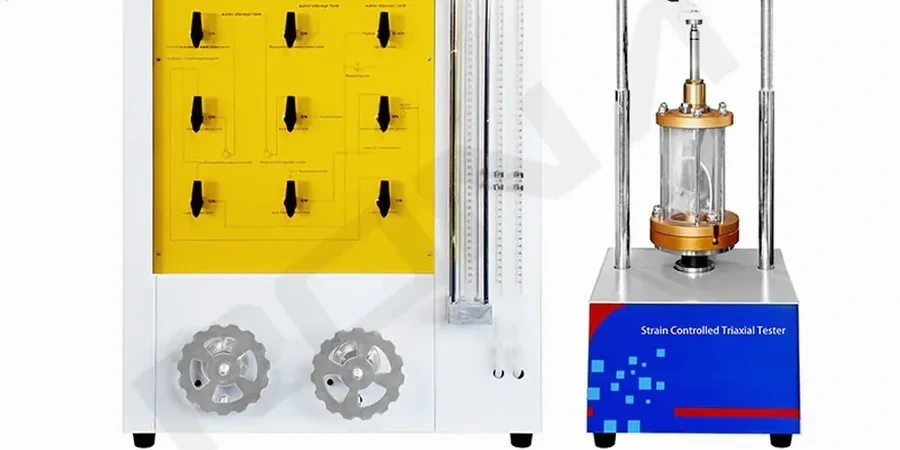
The triaxial frame we mobilize for Montgomery projects is a closed-loop servo-controlled system with a five-kip load cell and a digital volume change indicator. The cell sits inside a temperature-controlled room because even a five-degree swing in the lab shifts the back-pressure reading enough to skew the B-check. The real hazard isn’t the machine—it’s the sample disturbance. Shelby tube samples from the Selma Chalk lose their natural water content fast during an Alabama summer. If the crew in the field doesn’t seal the tube ends with microcrystalline wax within fifteen minutes of extrusion, the chalk micro-fractures and the lab gets a drained friction angle three degrees lower than reality. That error propagates into a footing width increase or a deeper pile cap. We counter it with a strict chain-of-custody protocol: field logs note the time between sampling and sealing, and the lab rejects any tube exceeding the limit before trimming the specimen.
Video overview
Relevant standards
ASTM D4767-11: Standard Test Method for Consolidated Undrained Triaxial Compression Test for Cohesive Soils, ASTM D7181-20: Standard Test Method for Consolidated Drained Triaxial Compression Test for Soils, ASTM D2850-15: Unconsolidated-Undrained Triaxial Compression Test on Cohesive Soils, IBC 2021 Chapter 18: Soils and Foundations, ASCE 7-22: Minimum Design Loads and Associated Criteria for Buildings and Other Structures
Additional services
Triaxial Test Suite
Consolidated-undrained, consolidated-drained, and unconsolidated-undrained tests on undisturbed Shelby tube samples, with back-pressure saturation and pore pressure measurement.
Advanced Soil Sampling
Thin-wall Shelby tube sampling with field wax sealing, chain-of-custody documentation, and transport in cushioned coolers to preserve natural moisture and structure.
Stress-Strain Parameter Analysis
Extraction of E50 secant modulus, failure strain, effective cohesion, and effective friction angle for PLAXIS, LPILE, or GROUP input decks.
Foundation Design Integration
Direct application of triaxial-derived shear strength to bearing capacity, settlement, and lateral earth pressure calculations per IBC and FHWA guidelines.
Typical parameters
Quick answers
When does a triaxial test replace a direct shear test on a Montgomery site?
Whenever the project involves an excavation deeper than ten feet, a mat foundation with eccentric loading, or a slope steeper than 2H:1V, the triaxial test gives the effective stress parameters that direct shear cannot. The Piedmont residual silts and Selma Chalk both develop significant pore pressure during construction, and only a triaxial cell with mid-height pore pressure measurement captures that undrained behavior. For routine shallow footings on level ground, direct shear may suffice, but the City of Montgomery building department often requests CU triaxial data for structures over three stories.
What is the typical turnaround time for a consolidated-undrained triaxial test?
Plan on ten to fourteen calendar days from sample receipt to report. The saturation stage alone can take two to four days on low-permeability chalk or clay, and the shear stage runs at a slow strain rate to allow pore pressure equalization. Multi-stage tests on a single specimen can shorten the schedule when the site investigation budget is limited, but we still need a full week for saturation, consolidation, and shearing across three confining pressures.
What does a triaxial testing program cost in Montgomery, Alabama?
A full CU triaxial test on one undisturbed Shelby tube sample, including back-pressure saturation, three effective confining pressures, pore pressure measurement, and a signed engineering report, runs between US$2,020 and US$2,940 depending on soil type and required strain rate. Multi-stage tests and drained CD tests fall within the same range. We provide a fixed-price quote after reviewing the boring logs and project specifications.