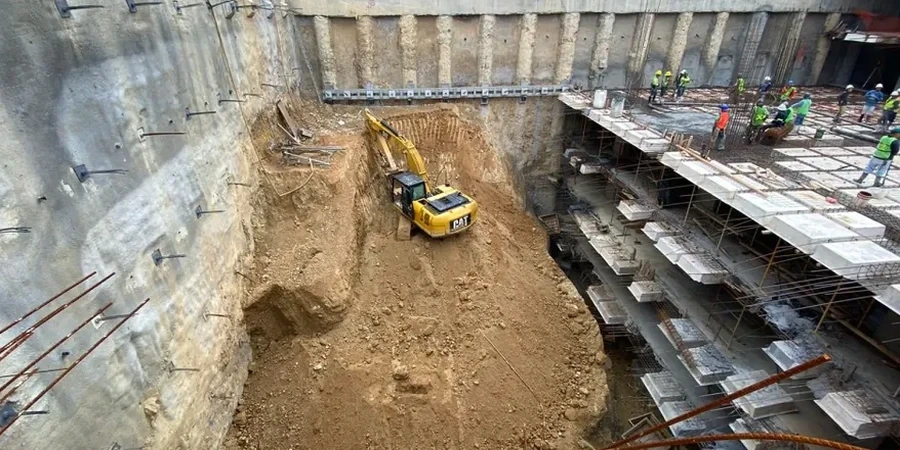
The biggest mistake we see in Montgomery is treating a 30-foot cut near the Alabama River like a textbook problem. The soil profile here doesn't read the manuals. You hit stiff Selma Chalk in one corner and loose alluvial sand in the other. Then the water table shows up 12 feet higher than the borings suggested. A standard shoring plan falls apart in those conditions. Our lab runs the full suite of strength tests before we touch a single calculation. That means triaxial compression on undisturbed Shelby tube samples and grain-size curves to nail down the drainage behavior. Only then do we apply the earth pressure models. For sites with deep sandy layers near Maxwell Air Force Base, we often pair the excavation design with a CPT test to capture the continuous soil profile without sample disturbance gaps that can hide weak seams.
In Montgomery, the groundwater table in the alluvium can fluctuate 8 feet between August and February. Your dewatering plan has to work in both seasons.
How we work
Local context
IBC Chapter 33 and the Montgomery building code require a geotechnical report that specifically addresses excavation stability for any cut deeper than 5 feet adjacent to a public right-of-way. The requirement isn't just paperwork. The Cretaceous chalk in this region weathers into a stiff fissured clay that holds a high peak strength but drops to nearly zero residual strength after movement. A small slip in an unsupported cut can cascade into a full bench failure. We model the excavation in both drained and undrained conditions because the rate of loading matters. A slow excavation in chalk behaves differently than a rapid one in the sandier Terrace Deposits found east of I-65. Our design explicitly defines the surcharge setback distances for equipment and stockpiles. In the downtown blocks, we also evaluate the vibration impact from sheet pile driving on adjacent historic masonry structures, a concern that comes up frequently near the Court Square district.
Video overview
Relevant standards
IBC 2021 Chapter 33 (Safeguards During Construction), ASCE 7-22 Section 12.13 (Earth Retaining Structures), FHWA GEC No. 4 (Ground Anchors and Anchored Systems), ASTM D4767 (Consolidated Undrained Triaxial Compression Test), Alabama Building Commission amendments to IBC
Additional services
Subsurface Investigation for Shoring Design
We drill and sample at the exact shoring wall alignment, not just at the building footprint. Continuous SPT sampling with thin-wall Shelby tubes at critical depths provides the strength and stiffness parameters for beam-on-elastic-foundation analysis.
Dewatering and Groundwater Control Plan
Based on in-situ permeability testing and grain-size curves, we design the dewatering system capacity, well spacing, and treatment requirements before discharge. We account for the seasonal river stage influence on the alluvial aquifer.
Excavation Sequencing and Monitoring Specification
We produce a staged excavation diagram that limits unsupported cut height and specifies the timing of tieback installation and preloading. The package includes threshold values for inclinometer deflection and settlement markers tied to the adjacent structures.
Typical parameters
Quick answers
What does a geotechnical design for a deep excavation in Montgomery cost?
For a typical commercial excavation in Montgomery, the geotechnical investigation and design package ranges from US$2,110 to US$7,450. The final cost depends on the cut depth, the number of borings required along the shoring line, and the complexity of the laboratory testing program. A 15-foot cut with simple soil conditions sits at the lower end. A 40-foot cut in the downtown chalk with tiebacks and dewatering design runs higher.
How do you handle the Selma Chalk when designing an excavation?
We treat the chalk as a transitional material between rock and stiff clay. Our lab measures the unconfined compressive strength from rock cores and the drained friction angle from triaxial tests. The design uses a bilinear strength envelope. We also specify a shotcrete facing or membrane cover if the chalk face will be exposed more than 72 hours. Air slaking reduces the chalk to a soft putty that loses all apparent cohesion.
What is the biggest deep excavation risk in Montgomery?
The groundwater in the alluvial terrace deposits. The Alabama River level drives the local water table, and it rises quickly after heavy rain. We have seen excavations flood overnight because the contractor relied on a single sump pump. Our design includes a redundancy factor on pump capacity and a standby generator requirement if the site loses power during a storm event.
Do you need to consider seismic loads for a shoring wall in Alabama?
Yes. Montgomery is in a moderate seismic zone with a design spectral acceleration SDS around 0.20g to 0.30g on Site Class D. ASCE 7-22 requires evaluating seismic earth pressure increments on retaining walls. We apply the Mononobe-Okabe method and check that the tieback anchors can handle the additional cyclic load without creep failure.