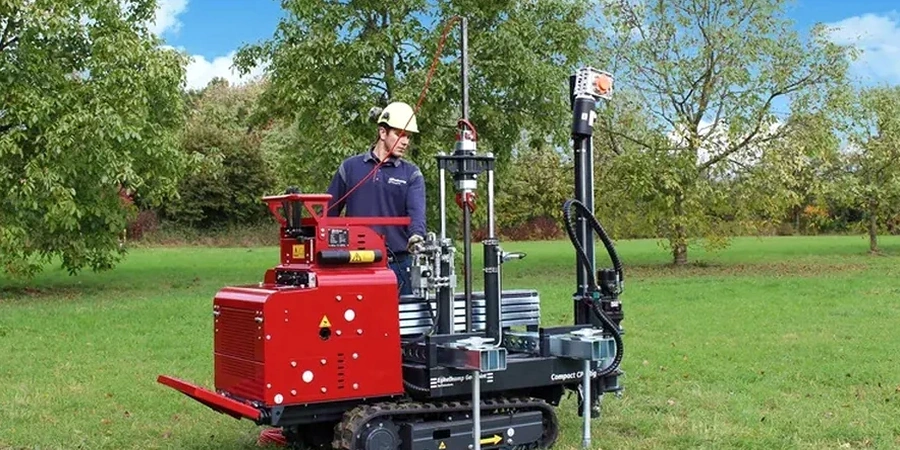
Montgomery sits on a tricky geological boundary. North of town you hit the Piedmont residuum—silty, micaceous stuff that weathers from crystalline rock. Head south and you're into the Black Belt's stiff overconsolidated clays, and along the Alabama River you get terrace sands and gravels that drain fast. A standard SPT can tell you something about these layers, but the CPT test gives you a continuous resistance profile that catches thin seams and transitions a split-spoon sampler misses. When a project timeline is tight and the foundation subgrade varies by the foot, we deploy a 20-ton cone rig with a 15 cm² tip and friction sleeve to log tip resistance, sleeve friction, and pore pressure in one push. It's the fastest way to get a stratigraphic picture without drilling spoils all over the site.
A single CPT push in Montgomery's Black Belt clay can tell you more about the stratigraphy than three borings—if you know how to read the friction ratio.
How we work
Local context
Here's something you learn after a few years running CPT in central Alabama: the refusal depth can be deceptive. In the Piedmont zone north of Montgomery, weathered mica schist can feel like dense soil to a SPT hammer but stop a cone dead at 30 feet. If you're designing deep foundations and assume refusal means competent rock, you might be in for a surprise when excavation reveals fractured material that won't take a pile tip. The other risk is pore pressure dissipation. In the stiff Selma Chalk clays south of town, pore pressures can take hours to dissipate after pushing, and if you skip the dissipation test, your effective stress parameters for settlement analysis are guesswork. We run at least one dissipation test per stratigraphic unit so the consolidation behavior goes into the geotech report, not into a footnote about what should have been done.
Relevant standards
ASTM D5778 — Standard Test Method for Electronic Friction Cone and Piezocone Penetration Testing of Soils, ASTM D2487 — Standard Practice for Classification of Soils for Engineering Purposes (Unified Soil Classification System), ASCE 7 — Minimum Design Loads and Associated Criteria for Buildings and Other Structures, IBC (Alabama adoption) — International Building Code with Alabama amendments
Additional services
Standard CPT (qc, fs, u2)
Continuous cone penetration with tip resistance, sleeve friction, and pore pressure measurement at 10 mm intervals. Ideal for stratigraphic profiling and soil behavior type classification in alluvial and residual soils.
Piezocone dissipation testing
We stop the push at target depths and record pore pressure decay over time. This gives you in-situ consolidation and permeability characteristics for settlement analysis in Montgomery's river terrace clays.
CPT with seismic module
Add a geophone array to the cone string for downhole shear wave velocity measurements. Useful where the IBC site class depends on Vs30 and the Piedmont residuum makes borehole methods unreliable.
Typical parameters
Quick answers
How deep can you push a CPT in Montgomery's soils?
It depends entirely on the formation. In the Black Belt clays south of Montgomery, we can often reach 60 to 80 feet before tip resistance climbs too high. In the Piedmont residual soils north of town, refusal can come at 20 to 40 feet when the cone hits weathered schist or gneiss. Our 20-ton rig handles most sites, but we'll tell you up front if the subsurface conditions in your area historically limit penetration depth.
What does a CPT test cost in Montgomery?
For a standard CPT push with qc, fs, and u2, you're looking at roughly US$140 to US$220 per hour of rig time, depending on depth, access conditions, and whether you need dissipation testing or seismic add-ons. Mobilization is a separate line item. We quote per project, not per foot, because the soil profile drives the schedule.
Do you need a separate drill rig for CPT?
The reference range for this service in Montgomery Alabama is US$140 - US$220. The final price depends on the project scope and volume.
Can CPT replace SPT borings completely?
In many profiles it can carry most of the load, especially where continuous stratigraphy matters. But CPT doesn't recover a soil sample, so if you need Atterberg limits or grain size distribution, you still need at least one boring to calibrate the cone data. We typically recommend pairing CPT with one or two SPT borings so you have index properties to anchor the soil behavior type interpretation.
How fast can I get the data after testing?
The cone data is digital from the moment it's recorded. We can send you raw qc, fs, and u2 files the same day, and a processed report with friction ratio, SBT classification, and pore pressure dissipation curves within 48 hours. If your structural engineer is waiting on IBC site class parameters, we prioritize the shear wave velocity data when the seismic module is used.