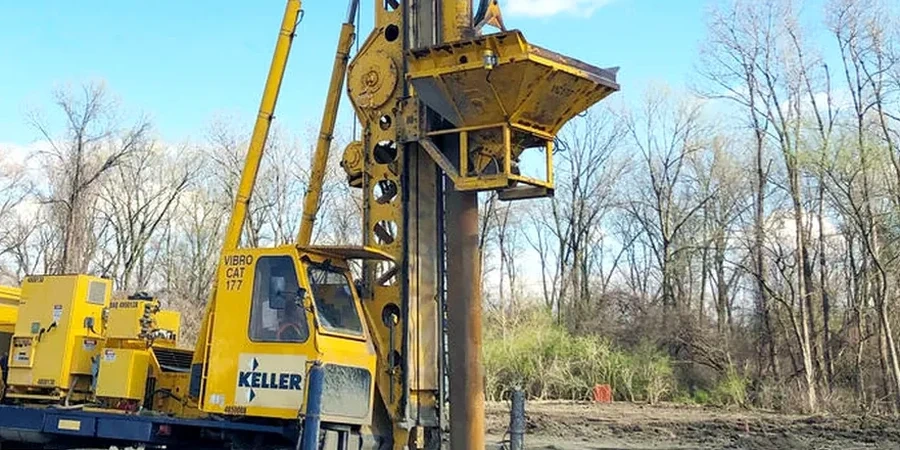
Montgomery sits at an elevation of roughly 240 feet above sea level, straddling the Fall Line where the Piedmont uplands meet the Gulf Coastal Plain. This geological boundary means subsurface conditions can shift dramatically within a single parcel: residual silts and stiff clays to the north, and loose alluvial sands along the Alabama River floodplain to the south. Deep densification becomes essential when a standard compaction effort cannot reach problematic granular layers at depth. Vibrocompaction design addresses exactly that challenge, tailoring probe spacing, vibration frequency, and withdrawal rates to the specific gradation encountered in each Montgomery borehole. A well-executed design cuts post-construction settlement to negligible levels, protecting slab-on-grade warehouses, bridge approaches, and mid-rise structures from differential movement. The approach also reduces the need for deep foundations where ground improvement can deliver equivalent bearing capacity at lower carbon footprint and cost.
A vibrocompaction design calibrated to Montgomery's Fall Line geology can double the allowable bearing pressure of loose alluvium while keeping total settlement under one inch.
How we work
Local context
Downtown Montgomery's historic clay overlies Cretaceous formations that are generally competent, but parcels within a half-mile of the Alabama River — particularly west of Maxwell Boulevard — often encounter 20 to 40 feet of loose Holocene sand that can liquefy or settle differentially under modest structural loads. A warehouse built on untreated alluvium in that corridor could see floor slab cracking within the first two wet-dry seasons. Contrast this with the compacted Piedmont residuum near EastChase, where bearing soils are stronger but variable boulders complicate probe penetration. The common risk across both zones is assuming that a single design template fits the entire metro area. It does not. A vibrocompaction design that performs well in the sandy river terrace will fail in the silty transition soils of the central business district unless the grid, energy input, and verification protocol are adjusted to the actual grain-size distribution measured on site.
Relevant standards
IBC 2024 (Alabama Building Code edition), ASCE 7-22 Minimum Design Loads – Chapter 20, ASTM D1586 Standard Test Method for SPT, ASTM D2487 Classification of Soils for Engineering Purposes, ASTM D4253/D4254 Maximum and Minimum Index Density of Soils
Additional services
Vibrocompaction Feasibility & Design
Desktop review of existing geotechnical data, grain-size curves, and groundwater levels to confirm vibrocompaction suitability. We produce signed and sealed design drawings showing probe grid, sequence, and target performance criteria for the Montgomery submittal package.
Pre- and Post-Treatment SPT Verification
Field drilling before and after vibrocompaction to quantify the increase in N-value and relative density. Reports include direct comparison of pre- and post-treatment logs, statistical analysis of improvement, and compliance letter for the building official.
Construction-Phase Quality Control
Real-time monitoring of vibrator depth, amperage, and duration during each probe penetration and withdrawal cycle. Daily QC reports document energy input per point and flag any deviation from the design grid, keeping the contractor accountable.
Typical parameters
Quick answers
What does vibrocompaction design cost for a typical Montgomery commercial lot?
For a standard commercial parcel under one acre in Montgomery, the vibrocompaction design package — including feasibility analysis, grid layout, and pre/post SPT verification planning — typically ranges from US$1,550 to US$5,240. The spread depends on available geotechnical data, treatment depth, and the number of verification boreholes required by the building official.
Which Montgomery soil types respond best to vibrocompaction?
Clean sands and gravelly sands with less than 12 percent fines passing the No. 200 sieve densify most efficiently. The loose alluvial deposits along the Alabama River floodplain south of downtown Montgomery are ideal candidates. Silty sands with 12 to 20 percent fines can still be improved but require closer probe spacing and often a brief resting period between passes to let pore pressure dissipate.
How long does a vibrocompaction design take to prepare?
Once the existing geotechnical report and site plan are in hand, a feasibility letter can be delivered within 5 business days. A full signed-and-sealed design package suitable for City of Montgomery permit review typically takes 10 to 15 business days, depending on the complexity of the subsurface profile and the number of treatment zones.
Does the Alabama Building Code require a special inspection for vibrocompaction?
Yes. Chapter 17 of the IBC as adopted by Alabama mandates special inspection for deep ground improvement methods including vibrocompaction. The statement of special inspections filed with the Montgomery building department must name the qualified inspector responsible for verifying grid layout, probe depth, energy parameters, and post-treatment testing before foundation concrete is placed. More info.