In Montgomery, we frequently see excavation plans that underestimate the lateral pressure generated by the local Selma Chalk formation when it weathers into stiff, expansive clay. The transition from the Blackland Prairie to the Coastal Plain creates a dual condition where a single soldier pile wall might not cut it. Our team designs both active and passive anchor systems to stabilize these cuts, particularly along the Alabama River bluffs where the water table rises fast after a heavy rain. For projects in the downtown historic district, where vibration limits are tight, we often specify passive anchors to avoid stressing adjacent masonry. When the soil profile reveals a limestone layer at depth, we combine the anchor design with a deep excavation monitoring plan to track wall deflection in real time.
In Montgomery's Yazoo clay, an active anchor's free length must clear the expansion zone or you'll lose prestress in a single dry season.
How we work
Local context
Montgomery’s downtown development pushes excavations deeper into the Cretaceous sediments, and that's where the risk profile shifts. The Selma Chalk isn't a solid rock; it's a soft, porous limestone that loses strength upon exposure to air and water. If you rely solely on a passive anchor block in weathered chalk, you might get progressive creep and a wall that moves more than the adjacent historic structures can tolerate. Then there's the Alabama River influence: rapid drawdown scenarios reduce the passive resistance dramatically. We've seen calculations where the passive wedge disappears entirely, leaving the wall hanging on the active anchors alone. That's why our design includes a 10-foot free length minimum and a corrosion protection level that accounts for the slightly acidic groundwater common in the Montgomery County area.
Relevant standards
IBC 2021 (International Building Code), ASCE 7-22 (Minimum Design Loads and Associated Criteria for Buildings and Other Structures), PTI DC35 (Post-Tensioning Institute - Recommendations for Prestressed Rock and Soil Anchors), ASTM A615 (Deformed and Plain Carbon-Steel Bars for Concrete Reinforcement), FHWA Geotechnical Engineering Circular No. 4 (Ground Anchors and Anchored Systems)
Additional services
Active Anchor Design & Load Testing
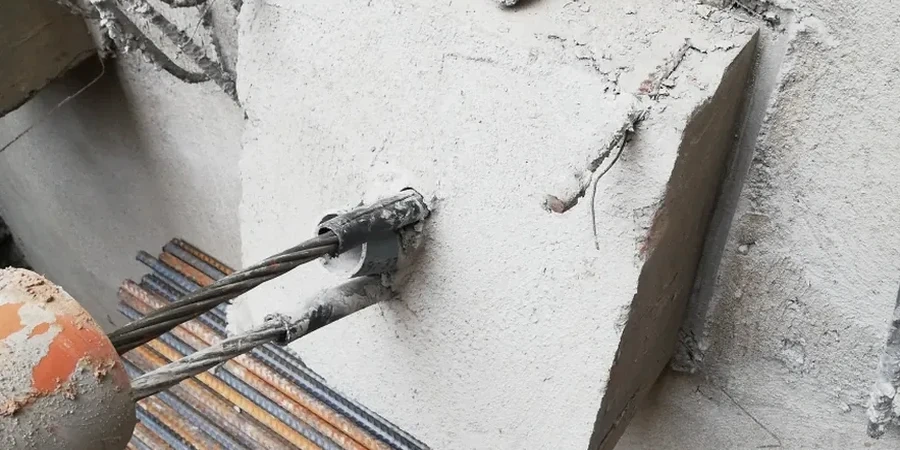
Post-tensioned anchor design with lock-off sequence scripts. We supervise the performance and proof testing on site, verifying the apparent free length and creep rate against the specified acceptance criteria.
Passive Anchor & Tieback Analysis
Grouted passive anchors designed for service-life conditions. We model the passive wedge interaction using limit equilibrium, adjusting for the low effective stress in the weathered Selma Chalk zone.
Typical parameters
Quick answers
What is the difference between an active and a passive anchor for a retaining wall in Montgomery?
An active anchor is post-tensioned after grouting; we apply a lock-off load that actively compresses the soil mass. A passive anchor isn't tensioned on purpose: it only reacts when the wall moves and engages the grout body. In Montgomery's stiff clays, active anchors control movement better, but passive anchors work well in the sandy layers where small deflections mobilize high resistance.
Do you design permanent corrosion protection for anchors in Alabama?
Yes. For permanent anchors, we specify a Class I protection system with double-corrosion barrier: corrugated sheathing, internal grout, and external grout. Montgomery's groundwater can be slightly acidic, and the Yazoo clay contains sulfates, so we don't take chances with tendon life.
How much does an active/passive anchor design cost for a Montgomery project?
For a typical design package including anchor sizing, bond length calculations, and testing specifications, the fee ranges from US$1,170 to US$4,000 depending on the number of anchors and complexity of the soil profile. A single wall with two rows of tiebacks falls on the lower end; a deep excavation with variable chalk elevations requires more analysis.
What acceptance criteria do you use for anchor proof testing in Montgomery?
We follow PTI DC35 guidelines. The anchor must hold the test load with a creep rate below 2 mm per log cycle of time, and the apparent free length must be within 80% to 115% of the theoretical unbonded length. If the anchor is seated in the Selma Chalk, we often extend the hold period to 60 minutes to catch any delayed creep.